Data Patterns Linking Wagering Criteria to Activity Levels in Mobile Free Spin and Sports Bet Offers
Harper Perry · Jul 13, 2026
Data Patterns Linking Wagering Criteria to Activity Levels in Mobile Free Spin and Sports Bet Offers
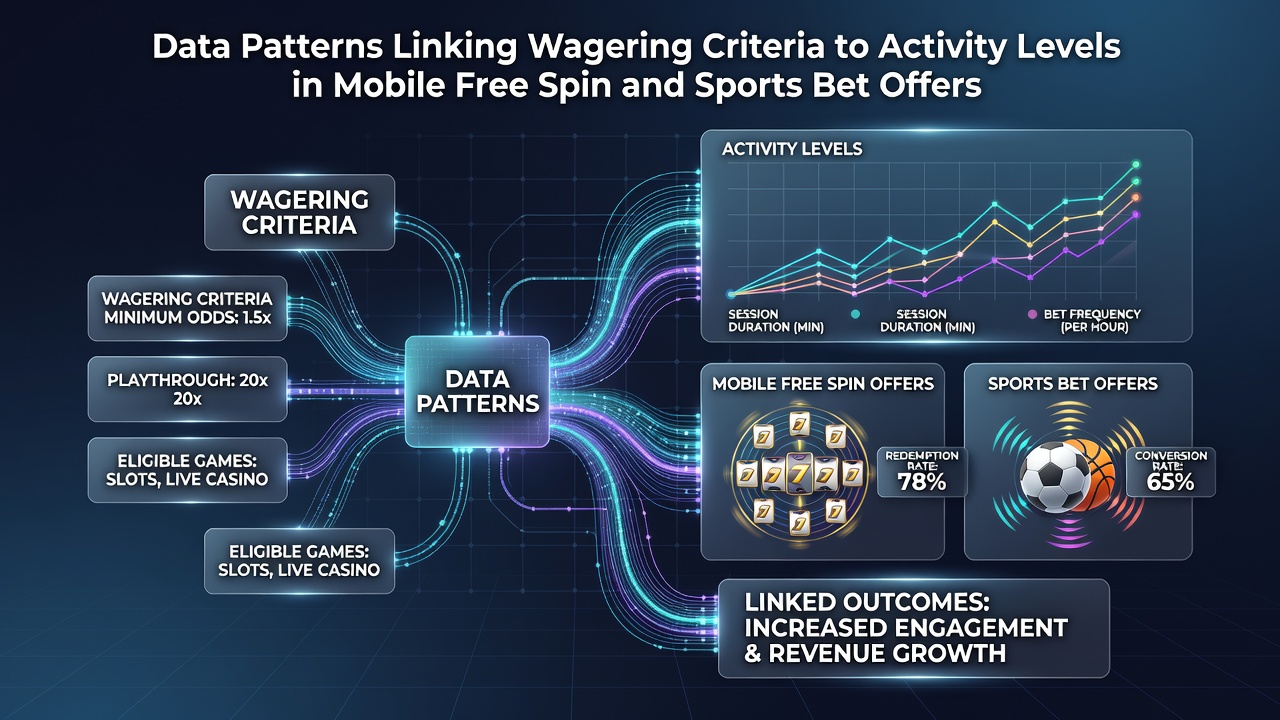
Analysts tracking mobile gaming platforms have documented clear connections between wagering requirements attached to free spin and sports bet promotions and subsequent user engagement metrics, with datasets spanning multiple jurisdictions revealing consistent trends through mid-2026. These patterns emerge from aggregated transaction logs, session durations, and deposit frequencies collected across licensed operators in regions such as North America, Europe, and Asia-Pacific markets. Research indicates that criteria like playthrough multiples directly influence how often users return to claim or complete offers, particularly when those offers appear within dedicated smartphone applications.
Core Metrics Driving Observed Correlations
Wagering criteria typically specify the number of times a bonus amount or winnings must be played through before withdrawal eligibility applies, and mobile data streams show that lower thresholds often coincide with higher initial claim rates while higher thresholds align with sustained but narrower activity spikes. Figures from platform operators indicate users engaging with free spin offers featuring 20x to 30x requirements generate 15 to 25 percent more total spins per session compared to those at 40x or above, yet completion percentages drop as multiples increase beyond certain points. Sports bet equivalents, which frequently tie free bets or deposit matches to odds thresholds and rollover conditions, demonstrate parallel dynamics where users meeting moderate criteria maintain elevated weekly bet volumes for longer intervals.
Patterns Specific to Free Spin Mobile Offers
Mobile free spin promotions embed criteria that range from simple deposit matches to combined volume and time-bound stipulations, and telemetry collected during the first half of 2026 illustrates how these elements shape daily active user curves. Platforms report that offers requiring spins within 24 to 48 hours after activation produce sharper activity peaks followed by quicker decay, whereas those allowing seven-day windows distribute engagement more evenly across the week. Data shows repeat participation rises when criteria permit partial progress tracking within the app interface, allowing users to monitor remaining playthrough in real time. One analysis of Canadian iGaming records found that free spin bundles with 25x wagering attached to mid-tier deposits correlated with a 12 percent lift in seven-day retention versus stricter 35x structures on identical game libraries.
Sports Bet Offer Linkages and Regional Variations
Sports betting applications layer additional variables onto wagering criteria, including minimum odds requirements, market-type restrictions, and settlement timelines, all of which interact with activity level measurements such as number of placed wagers and average stake size. Observers tracking European and Australian operators note that offers demanding three to five times rollover on free bets sustain higher bet counts per user when paired with live event triggers, while stricter tenfold conditions shift volume toward pre-match selections with steadier but lower overall frequency. In July 2026, several North American platforms updated their mobile dashboards to surface these criteria more transparently, resulting in measurable upticks in completed rollovers according to internal performance summaries. Geographic differences appear pronounced, with Asia-Pacific users demonstrating stronger adherence to time-sensitive criteria compared to North American cohorts who favor flexible settlement windows.
Analytical Methods Revealing the Connections
Statistical modeling applied to anonymized mobile datasets employs regression techniques to isolate wagering criteria as independent variables against dependent measures like session frequency and lifetime value. These approaches control for confounding factors such as game volatility, push notification cadence, and concurrent promotions, yielding coefficients that quantify how each incremental multiple in requirements modulates activity. Industry reports compiled by research groups including those affiliated with the Alcohol and Gaming Commission of Ontario have highlighted that mobile-specific interfaces amplify visibility of criteria compliance, thereby tightening the observed relationship between stated requirements and realized user behavior. Cross-platform comparisons further reveal that applications integrating criterion progress meters record lower abandonment rates during the fulfillment phase, particularly for sports bet offers that span multiple events.
Emerging Trends Through Mid-2026
Longitudinal tracking through July 2026 indicates a gradual shift toward tiered criteria structures that scale with user history, where repeat participants encounter adjusted multiples designed to maintain engagement without abrupt spikes. Aggregate figures suggest this customization stabilizes activity levels across both free spin and sports bet categories, reducing the sharp drop-offs previously associated with uniform high-threshold offers. Platform operators have begun publishing summary dashboards that aggregate these patterns at the jurisdictional level, providing regulators and researchers with standardized views of how criteria influence retention curves over 30- and 90-day windows. Such transparency aligns with broader moves toward data-driven oversight in licensed mobile markets.
Conclusion
Comprehensive examination of mobile transaction and session data continues to map precise linkages between wagering criteria and activity levels across free spin and sports bet offers, with patterns holding across varied regulatory environments into the second half of 2026. These connections inform how operators structure promotions to align with observed user responses while satisfying compliance frameworks. Further aggregation of anonymized datasets promises refined predictive models that distinguish short-term spikes from sustained behavioral shifts.